
Looking after our team members
Northumberland National Park MRT © Will Close Ash
It’s a day most team members say they dread — and would walk over hot coals to avoid — but when the chips are down, who better to treat you and carry you to safety than your own trusted mountain rescue colleagues?
From the archive: Mountain Rescue England and Wales Annual Review 2026.
May 2025 saw not one, but two such incidents, one in a quarry in Lancashire, the other in the Lakes. One case in particular proved a case study in how the Rescue Benevolent Fund can support team members in need.
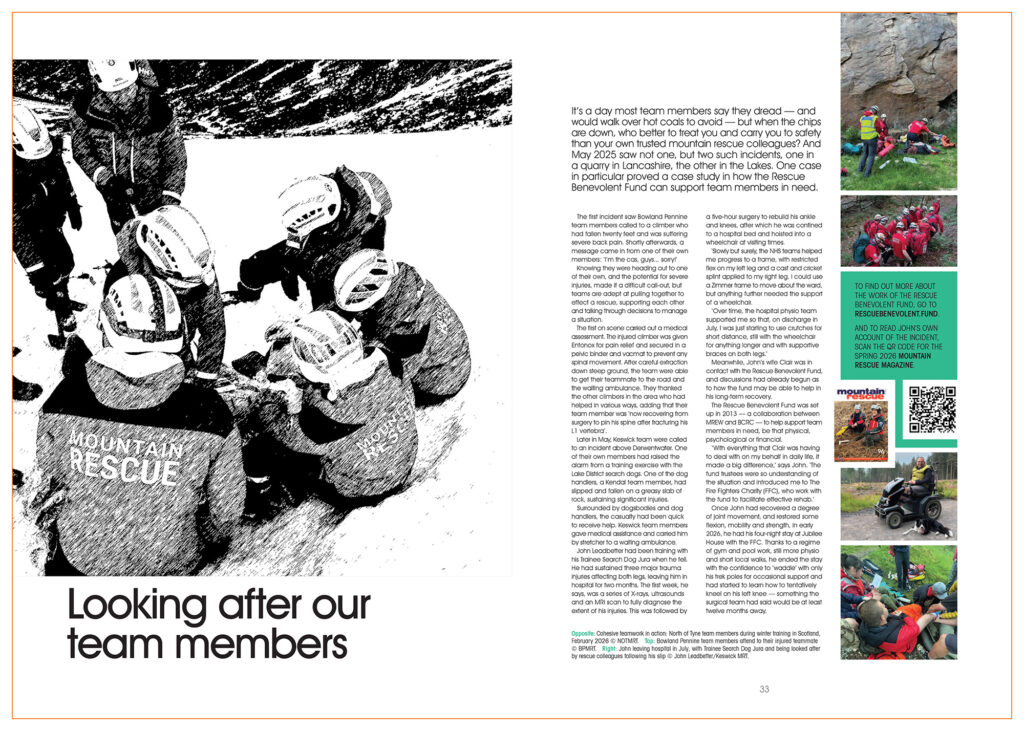
The first incident saw Bowland Pennine team members called to a climber who had fallen twenty feet and was suffering severe back pain. Shortly afterwards, a message came in from one of their own members: ‘I’m the cas, guys… sorry!’
Knowing they were heading out to one of their own, and the potential for severe injuries, made it a difficult call-out, but teams are adept at pulling together to effect a rescue, supporting each other and talking through decisions to manage a situation.
The first on scene carried out a medical assessment. The injured climber was given Entonox for pain relief and secured in a pelvic binder and vacmat to prevent any spinal movement. After careful extraction down steep ground, the team were able to get their teammate to the road and the waiting ambulance. They thanked the other climbers in the area who had helped in various ways, adding that their team member was ‘now recovering from surgery to pin his spine after fracturing his L1 vertebra’.
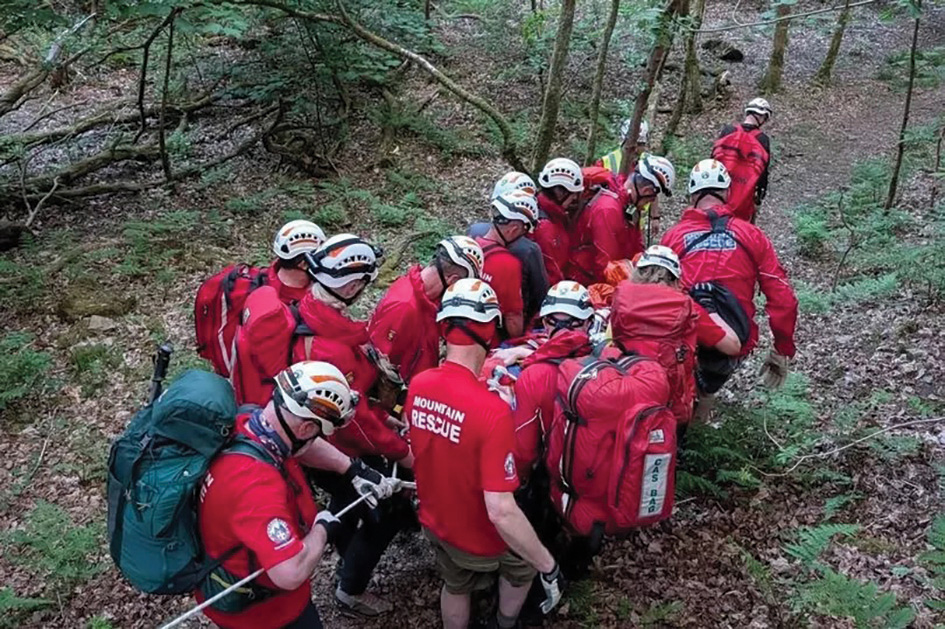
Later in May, Keswick team were called to an incident above Derwentwater.
One of their own members had raised the alarm from a training exercise with the Lake District search dogs. One of the dog handlers, a Kendal team member, had slipped and fallen on a greasy slab of rock, sustaining significant injuries.
Surrounded by dogsbodies and dog handlers, the casualty had been quick to receive help. Keswick team members gave medical assistance and carried him by stretcher to a waiting ambulance.
John Leadbetter had been training with his Trainee Search Dog Jura when he fell. He had sustained three major trauma injuries affecting both legs, leaving him in hospital for two months. The first week, he says, was a series of X-rays, ultrasounds and an MRI scan to fully diagnose the extent of his injuries. This was followed by a five-hour surgery to rebuild his ankle and knees, after which he was confined to a hospital bed and hoisted into a wheelchair at visiting times.
‘Slowly but surely, the NHS teams helped me progress to a frame, with restricted flex on my left leg and a cast and cricket splint applied to my right leg. I could use a Zimmer frame to move about the ward, but anything further needed the support of a wheelchair.
‘Over time, the hospital physio team supported me so that, on discharge in July, I was just starting to use crutches for short distance, still with the wheelchair for anything longer and with supportive braces on both legs.’
Meanwhile, John’s wife Clair was in contact with the Rescue Benevolent Fund, and discussions had already begun as to how the fund may be able to help in his long-term recovery.
The Rescue Benevolent Fund was set up in 2013 — a collaboration between MREW and BCRC — to help support team members in need, be that physical, psychological or financial.
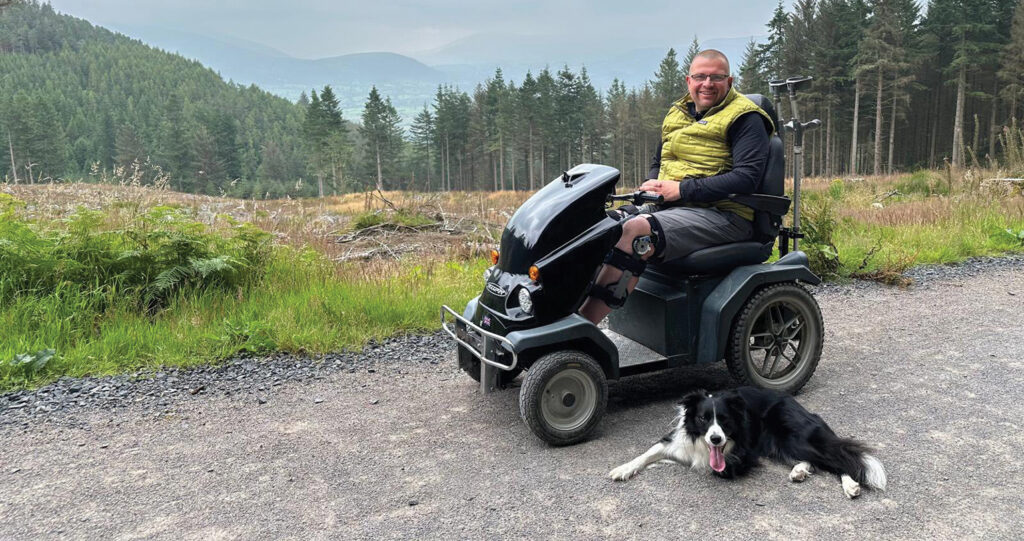
‘With everything that Clair was having to deal with on my behalf in daily life, it made a big difference,’ says John. ‘The fund trustees were so understanding of the situation and introduced me to The Fire Fighters Charity (FFC), who work with the fund to facilitate effective rehab.’
Once John had recovered a degree of joint movement, and restored some flexion, mobility and strength, in early 2026, he had his four-night stay at Jubilee House with the FFC. Thanks to a regime of gym and pool work, still more physio and short local walks, he ended the stay with the confidence to ‘waddle’ with only his trek poles for occasional support and had started to learn how to tentatively kneel on his left knee — something the surgical team had said would be at least twelve months away.