
Understanding what we mean by ‘trauma’
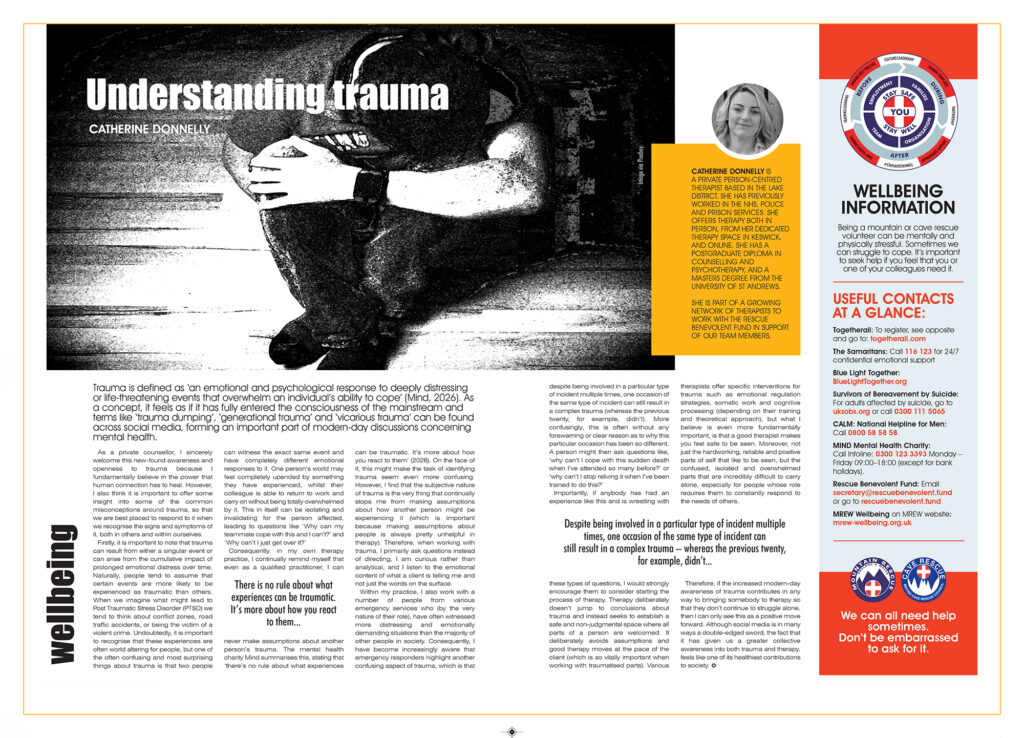
Image via Pixabay.
Trauma is defined as ‘an emotional and psychological response to deeply distressing or life-threatening events that overwhelm an individual’s ability to cope’ (Mind, 2026). As a concept, it feels as if it has fully entered the consciousness of the mainstream and terms like ‘trauma dumping’, ‘generational trauma’ and ‘vicarious trauma’ can be found across social media, forming an important part of modern-day discussions concerning mental health.
From the archive: Mountain Rescue Magazine Issue 96, April 2026. Catherine Donnelly is part of a growing network of therapists who work with the Rescue Benevolent Fund. A person-centred therapist based in the Lake District, she has previously worked in the NHS, police and prison services.
As a private counsellor, I sincerely welcome this new-found awareness and openness to trauma because I fundamentally believe in the power that human connection has to heal. However, I also think it is important to offer some insight into some of the common misconceptions around trauma, so that we are best placed to respond to it when we recognise the signs and symptoms of it, both in others and within ourselves.
Firstly, it is important to note that trauma can result from either a singular event or can arise from the cumulative impact of prolonged emotional distress over time. Naturally, people tend to assume that certain events are more likely to be experienced as traumatic than others. When we imagine what might lead to Post Traumatic Stress Disorder (PTSD) we tend to think about conflict zones, road traffic accidents, or being the victim of a violent crime.
Undoubtedly, it is important to recognise that these experiences are often world altering for people, but one of the often confusing and most surprising things about trauma is that two people can witness the exact same event and have completely different emotional responses to it. One person’s world may feel completely upended by something they have experienced, whilst their colleague is able to return to work and carry on without being totally overwhelmed by it. This in itself can be isolating and invalidating for the person affected, leading to questions like ‘Why can my teammate cope with this and I can’t?’ and ‘Why can’t I just get over it?’
There is no rule about what experiences can be traumatic. It’s more about how you react to them…
I continually remind myself that even as a qualified practitioner, I can never make assumptions about another person’s trauma. The mental health charity Mind summarises this, stating that ‘there’s no rule about what experiences can be traumatic. It’s more about how you react to them’ (2026). On the face of it, this might make the task of identifying trauma seem even more confusing. However, I find that the subjective nature of trauma is the very thing that continually stops me from making assumptions about how another person might be experiencing it (which is important because making assumptions about people is always pretty unhelpful in therapy). Therefore, when working with trauma, I primarily ask questions instead of directing, I am curious rather than analytical, and I listen to the emotional content of what a client is telling me and not just the words on the surface.
Within my practice, I also work with a number of people from various emergency services who (by the very nature of their role), have often witnessed more distressing and emotionally demanding situations than the majority of other people in society. Consequently, I have become increasingly aware that emergency responders highlight another confusing aspect of trauma, which is that despite being involved in a particular type of incident multiple times, one occasion of the same type of incident can still result in a complex trauma (whereas the previous twenty, for example, didn’t).
More confusingly, this is often without any forewarning or clear reason as to why this particular occasion has been so different. A person might then ask questions like, ‘why can’t I cope with this sudden death when I’ve attended so many before?’ or ‘why can’t I stop reliving it when I’ve been trained to do this?’
Despite being involved in a particular type of incident multiple times, one occasion of the same type of incident can still result in a complex trauma — whereas the previous twenty, for example, didn’t…
Importantly, if anybody has had an experience like this and is wrestling with these types of questions, I would strongly encourage them to consider starting the process of therapy. Therapy deliberately doesn’t jump to conclusions about trauma and instead seeks to establish a safe and non-judgmental space where all parts of a person are welcomed. It deliberately avoids assumptions and good therapy moves at the pace of the client (which is so vitally important when working with traumatised parts). Various therapists offer specific interventions for trauma such as emotional regulation strategies, somatic work and cognitive processing (depending on their training and theoretical approach), but what I believe is even more fundamentally important, is that a good therapist makes you feel safe to be seen. Moreover, not just the hardworking, reliable and positive parts of self that like to be seen, but the confused, isolated and overwhelmed parts that are incredibly difficult to carry alone, especially for people whose role requires them to constantly respond to the needs of others.
…social media is a double-edged sword, but the fact that it has given us a greater collective awareness into both trauma and therapy, feels like one of its healthiest contributions to society.
Therefore, if the increased modern-day awareness of trauma contributes in any way to bringing somebody to therapy so that they don’t continue to struggle alone, then I can only see this as a positive move forward. Although social media is in many ways a double-edged sword, the fact that it has given us a greater collective awareness into both trauma and therapy, feels like one of its healthiest contributions to society.