Slow down and smell the coffee
Are you always in a hurry, impatient in queues and flying off the handle at the slightest thing? Are you driven by a need to succeed and feel stressed-out most of the time? Find out how to take time to slow down, ‘be present’ and enjoy life.
From the archive: Mountain Rescue Magazine, Issue 94, Autumn 2025. Courtesy of Togetherall.
Psychologists have called this ‘Type A’ behaviour and the stress it causes has been associated with heart disease, high blood pressure and ulcers. The good news is that these characteristics are not fixed in stone as part of your personality, you can unlearn them. It just takes time and practice.

Step 1: Identify your own ‘Type A’ behaviours
First you need to think about those Type A behaviours that apply to you. Does any of this sound familiar?
Do you… do everything at high speed (eating, talking, walking…)? Get impatient waiting in queues or traffic jams? Become easily irritated over minor things? Find it hard to listen to other people and finish their sentences for them? Drive fast, always overtaking and weaving in out of the lanes? Create unnecessary deadlines and fill your calendar with appointments? Play games only to win (even against children)? Grind your teeth and clench your jaw?
Are you… constantly multi-tasking — trying to do lots of things at the same time (and thinking of what you’re going to do next when you’re working on something else)? Are you always late for appointments, very competitive — you always have to win or succeed — or over critical of everyone, including yourself? Are you a workaholic? Short-tempered?
Over the next week, make a note every time you find yourself doing or experiencing one of these things.
Step 2: Stop and think: are your ways of behaving getting you anywhere?
Time is of the essence to Type As — the quicker they can do things, the better. But doing things faster doesn’t always work — you may make mistakes that could have been avoided if you’d spent more time and consideration. Plus, some ways of doing things may not be effective as you think. Look at your list of the behaviours and consider a time when you acted in this way — and what the outcome was.
Are you actually achieving what you want to achieve? For example, if you’re an impatient, fast driver, time yourself driving a familiar route in your usual manner. Then make the same journey again but, this time, drive without constantly overtaking and try to stay calm. How much time did you save by driving the ‘fast’ (and stressful) way? The chances are, not very much.
Step 3: Think of ways to do the complete opposite
Take your list of Type A behaviours and for each one think of a way of doing the complete opposite to counteract it. These don’t have to be complicated: keep it simple. Here are some examples:
- ‘I bolt my food’ might be counteracted by ‘I will take at least thirty minutes over a meal’
- ‘I’m always driving at the top of the speed limit in the fast lane’ might be counteracted by ‘I will drive mainly in the slow lane’
- ‘I constantly schedule in meetings back to back’ might be counteracted by ‘I will cancel some of my meetings and schedule new ones in, with enough time in between to get myself together’
- ‘I always multi-task’ might be counteracted with ‘I will make myself concentrate on just one task at a time’.
Step 4: Devise a weekly programme
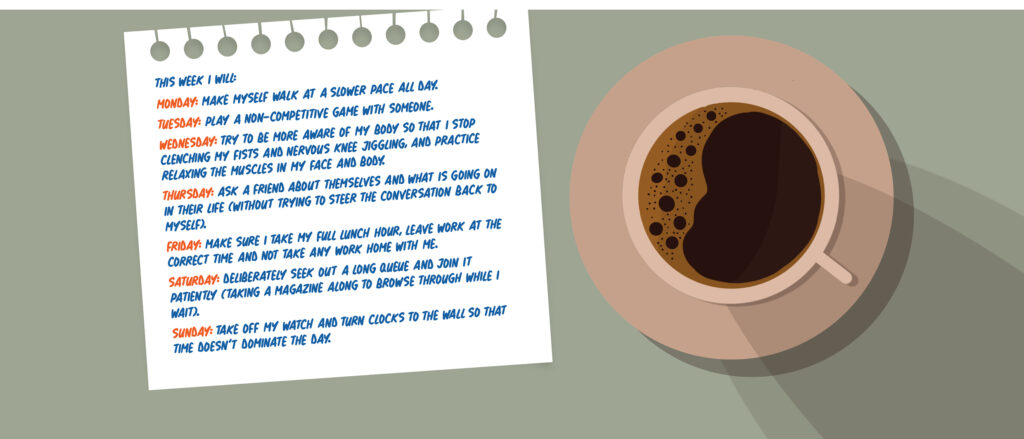
Once you have a complete list, you need to draw up a weekly programme to put these opposites into practice. You won’t be able to change everything at once, so approach it gradually. Choose seven different behaviours. For example:
- I’m always rushing everywhere
- I always play to win
- I clench my fists and jiggle my legs
- I find it difficult to listen to others
- I’m a workaholic
- I can’t stand lines
- I’m constantly watching the clock.
Each day over the following week concentrate on dealing with just one of these behaviours. In your diary, write down what you’re going to do — and then make sure you do it.
Once you’ve completed the first week, draw up a list for the second week, with more of the Type A behaviours you want to change. After this, draw up a list for the next month. Keep it simple and you’ll stand more chance of sticking to it. You’ll find that, over time, your Type A habits will gradually change.
Next steps
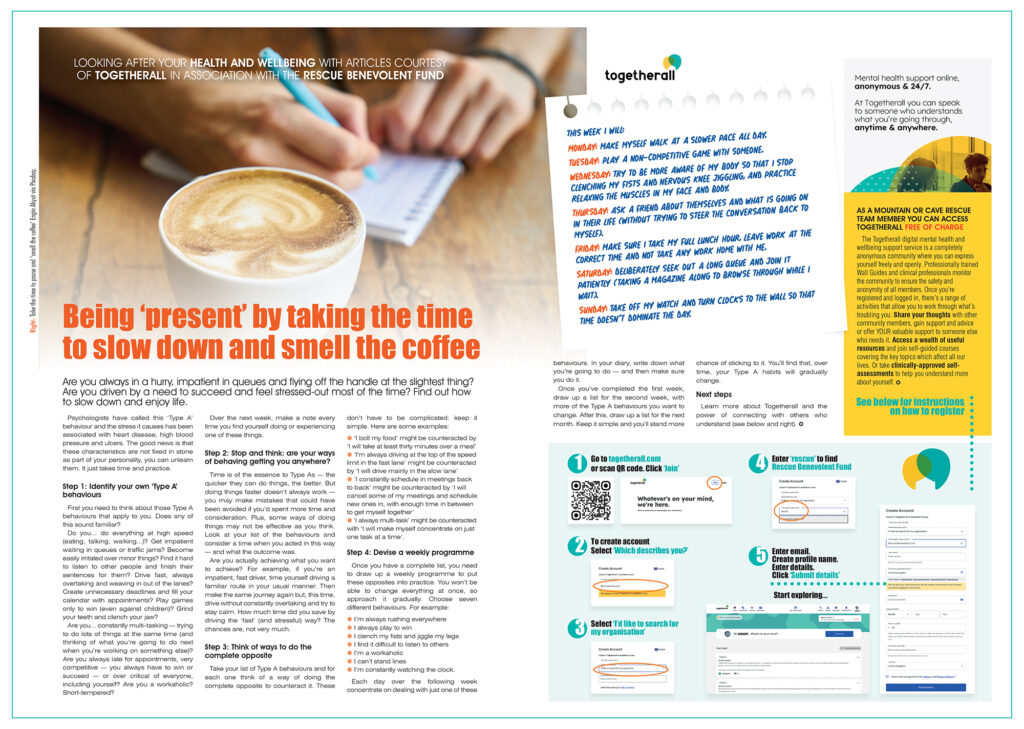
Learn more about Togetherall and the power of connecting with others who understand (see below and right). ✪
Mountain Rescue England and Wales and British Cave Rescue Council members in England and Wales can access Togetherall free of charge
The Togetherall digital mental health and wellbeing support service is an anonymous community where you can express yourself freely and openly. Professionally trained Wall Guides and clinical professionals monitor the community to ensure the safety and anonymity of all members. Once you’re registered and logged in, there’s a range of activities that allow you to work through what’s troubling you.
Share your thoughts with other community members, gain support and advice or offer YOUR valuable support to someone else who needs it. Access a wealth of useful resources and join self-guided courses covering the key topics which affect all our lives. Or take clinically-approved self-assessments to help you understand more about yourself.
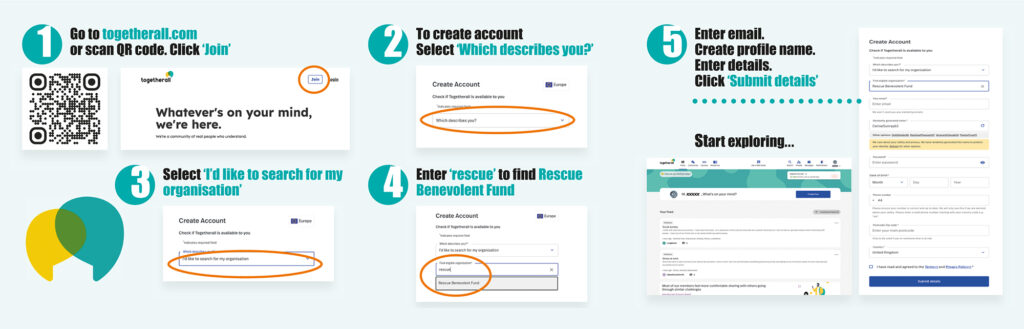
How to register…